

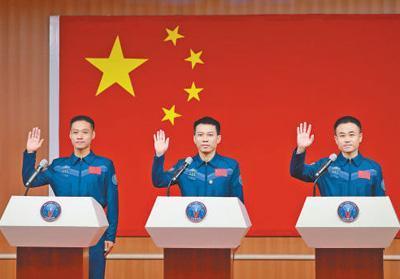
On the morning of October 25th, astronauts Tang Hongbo (center), Tang Shengjie (right), and Jiang Xinlin (left) of the Shenzhou 17 manned flight mission met with Chinese and foreign media reporters in Wentiange, Jiuquan Satellite Launch Center. Photographed by our reporter Fan Liuyi
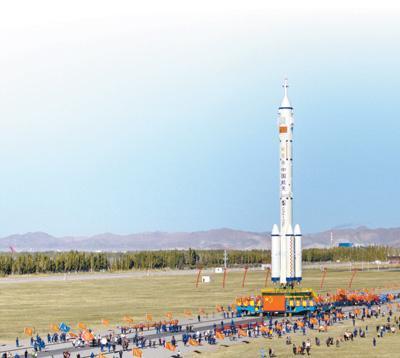
On October 19th, the combination of the Shenzhou-17 manned spacecraft and the Long March 2F Yao-17 carrier rocket was in transit. Photographed by Wang Jiangbo (Xinhua News Agency)
On the morning of October 25th, a press conference on the Shenzhou 17 manned flight mission was held at the Jiuquan Satellite Launch Center. Lin Xiqiang, spokesperson for the China Manned Space Engineering and deputy director of the China Manned Space Engineering Office, introduced the relevant information of the Shenzhou 17 manned flight mission.
After research by the mission headquarters, it was decided to launch the Shenzhou 17 manned spacecraft at 11:14 Beijing time on October 26. The flight crew consisted of astronauts Tang Hongbo, Tang Shengjie, and Jiang Xinlin, with Tang Hongbo serving as the commander. Tang Hongbo has participated in the manned flight mission of Shenzhou 12, and Tang Shengjie and Jiang Xinlin both made their first flights.
This mission is the 30th and 12th manned spaceflight mission since the implementation of the manned space engineering project. The main purpose of the mission is to complete the in orbit rotation with the Shenzhou 16 crew, stay for about 6 months, conduct in orbit experiments on space science and application payloads, carry out astronaut extravehicular activities and payloads, install extravehicular payloads, and maintain and repair the space station. At the same time, Continuously evaluate the functional performance of the space station assembly, obtain valuable data and experience on the operation of the space station, assess the coordination and matching of the ground support center in executing space station operation management tasks, and further improve the operational efficiency and fault handling ability of the space station.
According to the plan, after the Shenzhou 17 manned spacecraft enters orbit, it will adopt an autonomous rapid rendezvous and docking mode to dock with the forward port of the Tianhe core module, forming a three module three ship combination. During the stay in orbit, the crew of Shenzhou-17 astronauts will receive visits and docking from the Tianzhou-7 cargo spacecraft and the Shenzhou-18 manned spacecraft. They plan to return to the Dongfeng landing site around April next year.
At present, all preparations before launch are ready. After completing the in orbit rotation mission with the Shenzhou 16 crew, the crew of the Shenzhou 17 crew aimed to return to the Dongfeng landing site on the 31st of this month.
For the first time, the second batch of astronauts led the third batch of new astronauts to carry out missions, and Tang Hongbo became the first person to return to the "Heavenly Palace"
Lin Xiqiang introduced that the composition of the Shenzhou 17 astronaut crew still adopts the strategy of using the old to lead the new, consisting of three astronauts, including one second batch of astronauts and two third batch of astronauts. It is the youngest average age astronaut crew since the launch of the space station construction mission. This is the first time that the second batch of astronauts have led the third batch of new astronauts to carry out missions. Tang Hongbo became the first person to return to the "Heavenly Palace".
With the entry of manned space engineering into the stage of space station application and development, crew rotation will be implemented on a regular basis, and the on-orbit work arrangement of crew will also tend to be normalized, mainly including six categories of work: normal rotation and supply of personnel and materials, care of space station assembly platforms, crew health management, on-orbit experiments, conducting science popularization and public welfare activities, and handling abnormal situations.
In addition to the normalization work mentioned above, the Shenzhou 17 manned flight mission will conduct experimental maintenance operations outside the space station for the first time. Currently, with the increasing number of space debris, it is inevitable that long-term spacecraft will be impacted by small particles in space. Preliminary inspections have found that the space station's solar wing has also been repeatedly impacted by small particles in space, causing minor damage.
This situation is under design consideration. At present, all functions and performance indicators of the space station meet the requirements. However, starting from the long-term operation and verification of technical capabilities of the space station, this mission will be conducted by the Shenzhou 17 astronaut crew through extravehicular activities for experimental maintenance, which is a highly challenging task.
The crew of Shenzhou 16 is expected to take the first "working photo" reflecting the full configuration of the space station before returning
Lin Xiqiang introduced that the Shenzhou 16 mission is the first manned flight mission in China after the manned space engineering entered the stage of space station application and development. With close cooperation between astronauts and ground science and technology personnel, the space application project is steadily advancing according to plan, with a total of 70 projects carried out in aerospace medicine, life ecology, biotechnology, materials science, fluid physics, fluid mechanics A large amount of experimental data has been obtained through space experiments such as aerospace technology and 8 studies on human factors engineering technology. Some experimental samples will be taken down with the Shenzhou 16 spacecraft, and some projects have achieved phased application results. The comprehensive benefits of the space station as a national space laboratory are gradually emerging. During this mission, they also successfully completed an astronaut exit activity, a "Tiangong Classroom" space lecture, multiple payload exits, and cooperated in completing the separation and evacuation of the Tianzhou-5 cargo spacecraft.
Due to the limitations of microgravity environment and space station capacity, material management has become an increasingly prominent new challenge. To this end, the Shenzhou 16 crew closely collaborated with the ground to develop a targeted plan for reducing and increasing the efficiency of in orbit material management. Under the leadership of the commander of the Shenzhou 16 crew, Jing Haipeng, a total of about 850 transfers of materials were made, and 135 pieces of material sorting information were feedback. The inventory and sorting of in orbit materials for the space station were fully completed, bringing a new look to the storage status and information management of the space station's materials, This has set a benchmark for the management of on-orbit materials for subsequent space stations.
In addition, before the return of the Shenzhou-16 crew, astronauts will use high-definition cameras to orbit the spacecraft and take photos of the space station assembly under visual conditions. It is expected to obtain a panoramic image of the space station assembly with Earth as the background for the first time in orbit, which will be the first "working photo" reflecting the full configuration of the space station.
The basic configuration of China's space station will be upgraded from a "T" configuration to a "X" configuration in the future
According to the plan, in the future, a sky survey space telescope will be launched for co orbit flight with the space station to carry out wide-area sky survey observations. In the future, extended modules will be launched in a timely manner to upgrade the basic configuration of the space station from a "T" configuration to a "X" configuration. The planned expansion module will include multiple fields of space science experimental cabinets and extravehicular experimental devices, expanding the application scale to meet the new needs of space science research and application. At the same time, it will also upgrade the facilities and equipment for astronauts' in orbit protective exercise, diet, hygiene, etc., to improve the level of work, life, and health support for astronauts in orbit. The project is currently in the development phase of the scheme.
In 2023, only one Tianzhou cargo spacecraft mission will be arranged, mainly due to two reasons: firstly, the cargo spacecraft's carrying capacity has been improved. In the past, standard cargo compartments were used for cargo spacecraft, and starting from Tianzhou VI, improved cargo compartments were used, increasing the loading space by about 24% and the loading weight by about 22%; Secondly, a material information system that links heaven and earth has been established, achieving precise replenishment. The supply efficiency continues to improve, and the frequency of subsequent cargo spacecraft launches may further decrease.
It is understood that China's space station material supply strategy has always been "pre emptive", and in the future, the launch of Tianzhou-7 will be taken as an example. The principle is that the combination of in orbit inventory at the time of launch and the upward volume of Tianzhou-7 can support astronauts to stay in orbit for one year. That is to say, a single supply of supplies from the Tianzhou-7 spacecraft can support the two astronauts, Shenzhou-17 and Shenzhou-18, to carry out missions in orbit.
China is ready to invite foreign astronauts to participate in China's space station mission
Lin Xiqiang introduced that currently, China has a complete near-Earth manned space station and a manned space shuttle transportation system, a mature astronaut selection, training, and support system, and a planned manned flight mission, which is implemented twice a year on a regular basis. China is ready to invite foreign astronauts to participate in the Chinese space station mission.
After the announcement of the overall plan collection for the low-cost cargo transportation system of the Chinese space station, a total of 9 units submitted 10 compliant plans. Through expert review and evaluation, four units received engineering support and entered the detailed design phase of the plan. Among them, multiple units have adopted the rocket solutions of private commercial aerospace rocket companies. These companies are each developing rockets with a carrying capacity of 4 to 6 tons, which have a high comprehensive cost-effectiveness. They have the hope of participating in the subsequent commercial procurement of rockets and executing low-cost cargo transport rocket launch missions for space stations.(Reporter Liu Shiyao and Gu Yekai from this newspaper)


